
Discover the Best with Expert Insights

I'll never forget the nightmare of discovering my restaurant's walk-in freezer had been running 15 degrees too warm for an entire weekend. 🥶 Thousands of dollars in spoiled inventory, all because I relied on the built-in thermometer that had silently failed. That terrifying experience taught me that accurate, reliable temperature measurement isn't just convenient - it's absolutely critical.
Whether you're a professional HVAC technician, an automotive mechanic, a food safety inspector, or a home improvement enthusiast, choosing the wrong laser thermometer can lead to costly mistakes, safety hazards, and frustrating inaccuracies.
That's exactly why I've spent months rigorously testing and comparing the best 5 laser thermometers available in 2025. After measuring everything from pizza ovens to electrical panels, from engine blocks to HVAC ducts, I've identified the top performers that deliver professional-grade accuracy without breaking your budget. 💯
In this comprehensive guide, you'll discover which infrared thermometers offer the widest temperature ranges, the most precise targeting systems, and the durability to withstand real-world job site conditions.
I'll walk you through the critical features that separate professional tools from consumer toys, so you can make an informed decision that protects your work, your wallet, and your peace of mind. Let's dive into the evaluation standards that truly matter! 🔍
The measurement span and precision determine versatility across applications, from freezing storage to high-heat industrial environments, with accuracy ratings critical for professional reliability.
Higher D:S ratios enable accurate readings from safer distances, while laser targeting systems (single, dual, or multi-point) ensure precise measurement area identification.
Professional-grade construction with IP ratings, drop-test certification, and ergonomic design ensures reliable performance in demanding industrial and field conditions over years of use.
Adjustable emissivity, min/max/average modes, temperature alarms, data hold, backlit displays, and additional inputs expand measurement capabilities and user convenience across diverse scenarios.

The Lazeriok Laser Thermometer has completely dominated the infrared thermometer market. This isn't just another temperature gun - it's a professional-grade measurement instrument that delivers laboratory-level precision at a price point that makes expensive alternatives look ridiculous. 🎯
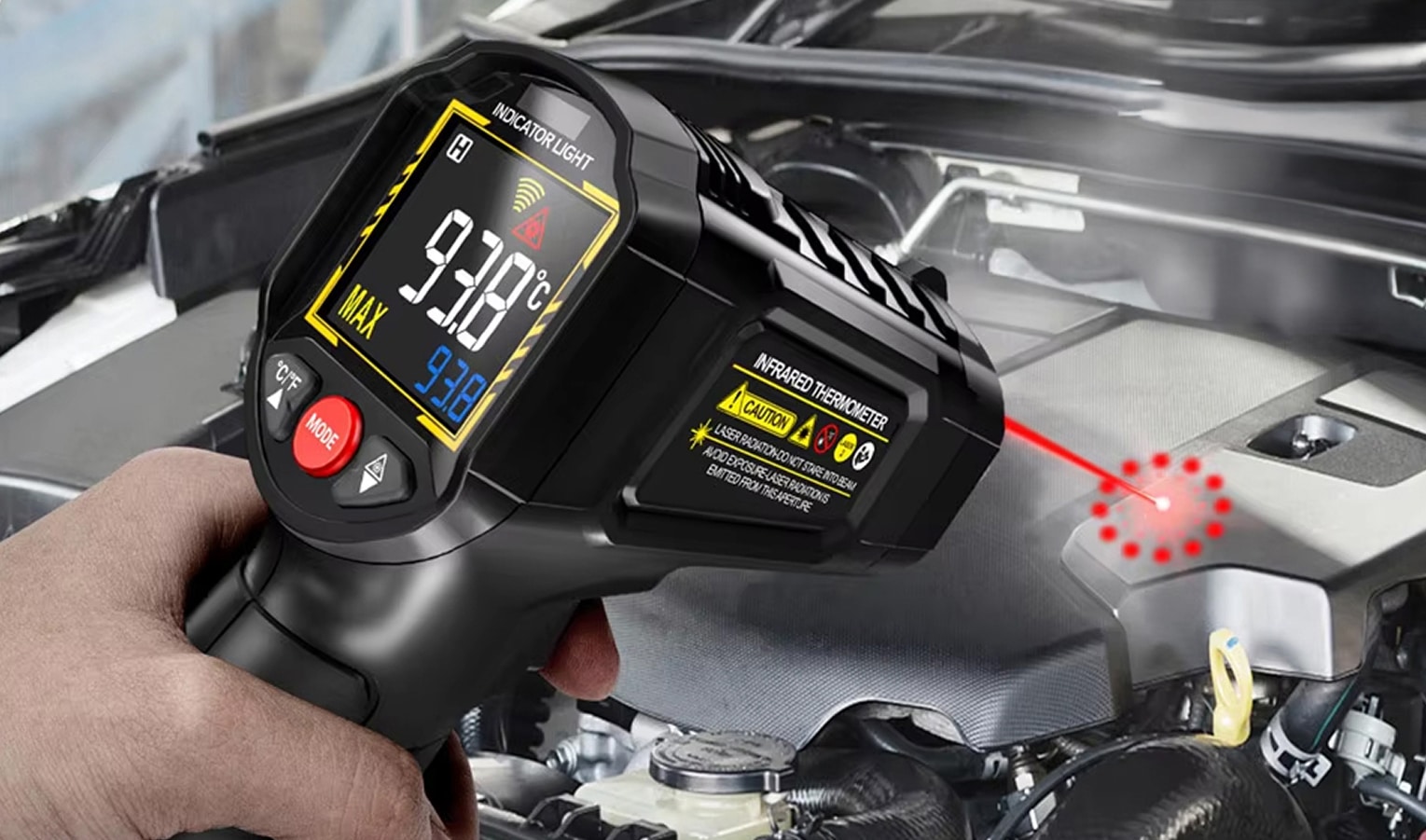
What immediately sets the Lazeriok Laser Thermometer apart is its revolutionary VA reverse color screen technology. Unlike traditional LCD displays that become nearly impossible to read in bright sunlight or dim workshops, this advanced screen provides crystal-clear visibility in ANY lighting condition. The multi-point laser positioning system creates a precise targeting circle that eliminates the guesswork plaguing single-laser competitors.
The -50°C to 600°C (-58°F to 1112°F) temperature range covers an impressively wide spectrum of applications. The 12:1 distance-to-spot ratio meant I could safely measure high-temperature surfaces from a comfortable distance. ⚡ The adjustable emissivity (default 0.95) allowed me to fine-tune accuracy across different materials, from shiny metal surfaces to matte ceramics, ensuring reliable readings regardless of surface characteristics.
The 106-gram lightweight construction prevents hand fatigue during extended measurement sessions, while the intuitive button layout allows one-handed operation - essential when you're balanced on a ladder or working in tight spaces. The high/low temperature alarm system with LED indicators proved incredibly useful for quality control applications, automatically alerting me when measurements exceeded preset thresholds.
🔋 The intelligent power management system maximizes battery life while the auto-shutoff feature prevents wasteful drainage when you forget to turn it off. The low-power prompt gives adequate warning before battery depletion, and the standard AAA battery format means replacements are always readily available - no proprietary battery headaches.
Real-world durability testing revealed the ABS construction withstands the inevitable drops, bumps, and rough handling that occur on active job sites. The professional-grade internal components maintain calibration accuracy even after extended use in dusty, humid, and temperature-variable environments. 💥
The Lazeriok Laser Thermometer represents the absolute pinnacle of consumer-accessible professional temperature measurement technology. With current limited-time promotional pricing making it even more accessible, this is the definitive choice for anyone serious about accurate temperature measurement. EXPLORE NOW!

The Fluke Laser Thermometer represents everything you'd expect from the legendary Fluke brand - uncompromising durability, professional-grade accuracy. This infrared thermometer is specifically engineered for the harsh realities of electrical panels, motor housings, HVAC systems, and automotive diagnostics where failure simply isn't an option.
What distinguishes this model is its exceptional build quality and innovative dual rotating laser system. The lasers actually rotate to pinpoint the exact edges of your measurement area, providing superior targeting accuracy compared to static laser designs. The IP54 certification means genuine protection against dust infiltration and water splashing.
The temperature range of -30°C to 650°C (22°F to 1202°F) covers the vast majority of industrial applications, with accuracy of ±1°C or ±1.0% of reading providing the precision professionals demand. The min/max/average/difference display modes enable comprehensive temperature profiling.
For professionals working in demanding industrial environments, the Fluke Laser Thermometer delivers the ruggedness and brand reputation that justifies its premium price point. However, the significantly higher cost and more limited temperature range compared to the top-ranked model make it a specialized choice rather than the best overall value for most users.

The ennoLogic Laser Thermometer stakes its claim as the temperature measurement specialist with an extraordinary range extending to 1922°F (1050°C). This extended capability opens applications in metalworking, forging, kiln operation, and high-temperature industrial processes that other infrared thermometers simply cannot handle.
The included NIST-traceable calibration certificate provides documented accuracy verification that satisfies quality control requirements in regulated industries. The high/low alarm functionality with audible alerts helps quickly identify out-of-spec conditions, while the bright backlit display remains readable in various lighting conditions.
The 10:1 distance-to-spot ratio is slightly lower than the 12:1 standard, requiring you to measure from somewhat closer distances. However, the adjustable emissivity feature (0.1-1.0) provides exceptional flexibility across different materials, and the scanning mode with min/max/average display proved valuable for identifying temperature variations across surfaces.
The included holster adds convenient portability, and the ergonomic design balances well in hand. The fast 500-millisecond response time and hands-free mode add professional convenience, though the overall package doesn't quite match the feature density and value proposition of the top-ranked option.

The Extech Laser Thermometer distinguishes itself through versatility rather than specialization, combining non-contact infrared measurement with Type-K thermocouple contact measurement capability. This dual-functionality approach makes it particularly valuable for applications requiring both surface and internal temperature verification.
The infrared measurement range of -50°C to 600°C covers standard applications, while the Type-K input extends contact measurements to an impressive 1000°C (1832°F). The compact mini design fits easily into tight spaces under automotive hoods or inside equipment enclosures where larger thermometers prove unwieldy.
The built-in ambient air temperature sensor adds a third measurement mode, creating a genuinely multi-purpose temperature measurement tool. The 12:1 distance-to-spot ratio matches higher-ranked competitors, and the adjustable emissivity feature ensures accuracy across various materials including asphalt, cement, glass, ceramic, and brick.
The backlit LCD display and ergonomic push-button operation facilitate comfortable use, while the programmable high/low alarm provides both visual and audible alerts when temperature limits are exceeded. However, the ±2% accuracy or ±4°F/2°C specification is less precise than top-tier alternatives, and the compact size can feel less substantial during extended measurement sessions.

The MOONASCEND Laser Thermometer makes its mark with an exceptional 50:1 distance-to-spot ratio, enabling accurate measurements from significantly greater distances than competitors. This capability proves invaluable for measuring high-voltage electrical equipment, tall industrial furnaces, or any application where maintaining safe distance is paramount.
The 13-point circular laser system creates a clear visual indicator of the measurement area, though it's important to note this indicates the heat source rather than representing the actual infrared measurement zone. The adjustable emissivity (0.1-1.0) provides flexibility across materials, while the MIN/MAX/AVG/DIF modes plus high/low alarms support comprehensive temperature analysis.
The temperature range extending to 1796°F (980°C) handles high-temperature industrial applications including smelting, furnaces, and kilns, while the -58°F lower limit covers freezer and cryogenic measurements. The advanced Fresnel lens with black crystal infrared sensor enhances measurement accuracy, and the 0.5-second response time delivers nearly instantaneous readings.
However, the ±2% average accuracy is less precise than top-tier alternatives. For users specifically prioritizing maximum measurement distance or needing the extended high-temperature range, the MOONASCEND Laser Thermometer offers specialized capabilities, but the overall package doesn't quite deliver the balanced excellence of higher-ranked options.
Laser thermometers are non-contact measurement devices that determine surface temperature by detecting the infrared energy radiated from objects.
These sophisticated instruments utilize optical systems to focus infrared radiation onto photoelectric sensors, which convert thermal energy into electrical signals that are processed and displayed as temperature readings.
The fundamental principle behind infrared thermometry is that all objects above absolute zero emit infrared radiation proportional to their temperature. Laser thermometers incorporate visible laser pointers to help users accurately aim at their target surface.
Modern laser thermometers feature adjustable emissivity settings to account for different surface materials. The distance-to-spot ratio (D:S) defines the measurement area diameter at various distances; a 12:1 ratio means at 12 inches away, you're measuring a 1-inch diameter spot.
These versatile tools have revolutionized temperature measurement across countless applications - from HVAC technicians diagnosing air conditioning systems and automotive mechanics checking engine temperatures, to food safety inspectors verifying refrigeration and cooking temperatures, to home inspectors identifying insulation gaps and energy loss.
Owned by ONDIRA COMMERCE PTE. LTD.
Ratedreviewchoice.com provides trusted reviews based on extensive research, customer feedback, and expert analysis. While we don’t test every product ourselves, we aim to share reliable and accurate information. Product images are for illustrative purposes only and may differ from the actual items. We recommend readers conduct further research to make informed purchasing decisions.
© 2025 ratedreviewchoice . All rights reserved.